
The sciatica nerve is the longest and thickest nerve in the body, formed from five nerve roots that originate in the lumbar spine, extend into the buttock region of the pelvis, and travel down the back side of each leg.
Sciatica refers to a set of symptoms that occur when the sciatic nerve is irritated and inflamed.
Patients may experience the symptoms of pain, tingling, numbness, and muscle weakness, anywhere along the sciatic nerve’s pathway. It is very common for the patient to have severe lower back pain, tingling, or numbness that starts in the lower back and radiates down one or both legs all the way to the big toe. Some patients will not experience any back pain at all but will have symptoms of pain, tingling, or numbness at various regions along the sciatica nerve, such as the buttocks, posterior leg, or calf muscle. In some cases, the patient will experience extreme leg weakness and difficulty walking and sitting.
Most of the time, the “root cause” of sciatica is a herniated disc in the lower back. 40% of people in the United States will develop sciatica, and more than three million people in the United States develop a herniated disc annually. If a herniated disc is not treated in the early stages, it will become worse, and in extreme cases of disc herniations, surgery may be required. A patient can develop cauda equina syndrome and lose bowel and bladder control, which will require emergency surgery.
There are many causes of sciatica. At Gonstead Physical Medicine, we will determine the “Root Cause” of your sciatica pain so our doctors can treat your health problem effectively and get you back to enjoying the things you love to do.
Why Is It Important to Work With a Team That Understands Personal Injury Cases?
Working with a team experienced in personal injury cases ensures proper documentation for legal and insurance purposes, coordinates care with attorneys and other providers, develops a treatment plan that supports both recovery and claim resolution, and bills and codes accurately according to personal injury insurance requirements. This clinic maintains a trusted network of personal injury attorneys, medical doctors, imaging centers, and rehabilitation providers to support patients through the entire process.
How Our Care Plan Works
Find It
Through our meticulous exam process we are going to find the root cause of your problem and show you exactly what is going on.
Fix It
We will develop a custom plan of attack using our comprehensive approach that won’t just have you feeling better in the short term but will give you the lasting results that you have been looking for.
Forget It
When you aren’t feeling 100% it is hard to focus on much else. Once we get you feeling and functioning better you will be able to forget all about your problem and get back to enjoying your life!
How We Treat Sciatica In Phoenix, AZ
Thorough Consultation and Examination
We must first determine the root cause of your sciatica symptoms. Determining the correct cause of the problem will dictate the course of treatment. Our chiropractic doctors will determine if your sciatica symptoms are caused by a spinal disc injury, disc degeneration, facet syndrome, spinal stenosis, piriformis syndrome, or subluxation.
A thorough consultation and complete history give our doctors the opportunity to really listen to you and understand how the problem started and how the sciatica pain is affecting your life. We can also capture key bits of information about your condition that can help our doctors determine the “root cause” of the problem that is creating your sciatica pain.
At Gonstead Physical Medicine, our doctors are trained to identify the “root cause” of your sciatica problem. We take a comprehensive, multifaceted approach to ensure that we diagnose your sciatica pain correctly.
- Complete spine and motion X-rays
- Orthopedic tests
- Functional movement tests
- Motion and static palpation
- Gonstead “nervoscope” instrument to assess inflammation and nerve interference
When we suspect lumbar disc displacement (protruded, bulging, herniated, or extruded disc), we’ll recommend a lumbar MRI without contrast. The lumbar MRI is the gold standard and the best imaging to confirm lumbar disc displacements, disc degeneration, and stenosis. The lumbar MRI is crucial to determining the integrity of the lumbar disc, making a proper diagnosis, and determining the most effective treatment for your sciatica problem.
For our patients’ convenience and to expedite the process, our doctors can schedule your appointment for your MRI from our office, and many patients can have their MRI the same day.
Once we determine the root cause of your sciatica problem, we will be able to give you the best treatment recommendations and get you back into your life, doing the things you love.

Natural Solutions for Sciatica Relief in Phoenix, AZ
Some of the therapies we use at Gonstead Physical Medicine to treat the root cause of your sciatica problems are:
- DRX 9000 Non-Surgical Spinal Decompression
- Chiropractic Adjustments
- Electric muscle stimulation
- Red light therapy
- Ice therapy
- Massage
- Strengthening exercises
- Lumbar support brace with Ice pack
- Nutrition (vitamin & supplements, and anti-inflammatory IV therapy)
- Topical analgesic products




Common Causes of Sciatica in Phoenix, AZ
Spinal Disc Displacement
In most cases, sciatica is caused by spinal disc displacement:
- Bulging Disc
- Herniated Disc
- Protruded Disc
- Extruded Disc
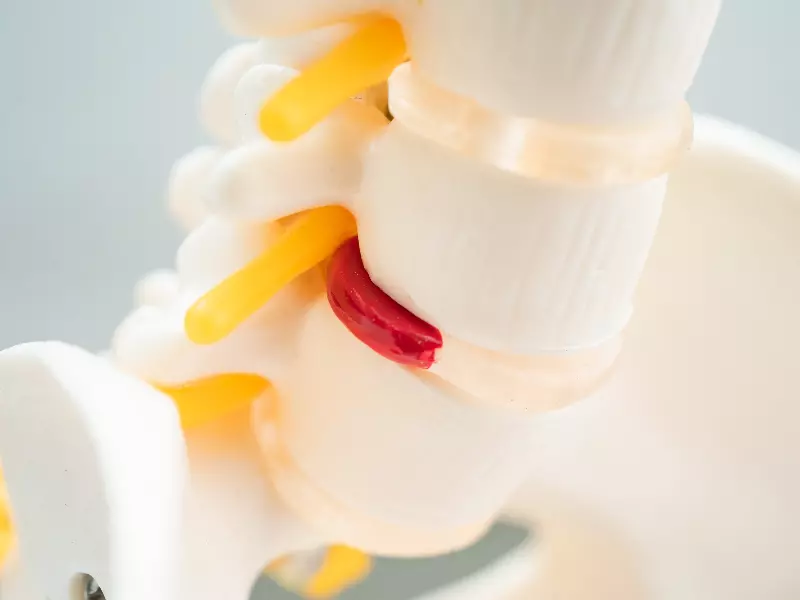
The spinal disc is similar to a jelly donut. It has a soft gel-like substance inside called the nucleus pulposus and a strong outer ligament structure called the annulus fibrosus.
When fibers of the annulus fibrosus weaken – from too much pressure on the disc resulting from lifting a heavy object, a car accident, a fall, or prolonged sitting in the car or at a desk – the nucleus pulposus becomes displaced. As pressure increases, a protrusion will form into a disc bulge and eventually will herniate into the spinal canal.
An extruded disc is when the annulus fibers tear and the nucleus starts to leak out.
A sequestered disc occurs when a portion of the extruded disc material breaks off, forming fragments that travel into the epidural space of the spinal cord.
Any form of disc displacement can eventually irritate and inflame the sciatic nerve, leading to sciatica symptoms. Disc displacements should be treated immediately, as they will get worse and may become a medical emergency, as in the case of cauda equina syndrome.
Degenerative Disc or Degenerative Joint Disease
Also called osteoarthritis, degenerative disc disease (DD) occurs when the spinal disc, which acts as a cushion of the spine and creates space between the spinal bones, begins to wear away, usually as a result of the excess pressure of normal wear and tear due to aging.
The spinal disc is mostly water, and the disc will start to dehydrate, which is also called a desiccated disc. When the spinal disc dehydrates, it becomes flattened and cannot perform its natural function of keeping space between the spinal bones. As a result, the spinal bones begin to rub on each other, also called facet syndrome. The spinal joint will start to degenerate and create bone fragments called osteophytes or bone spurs around the joint, which can eventually lead to the joint being immobile and causing the joint to fuse.
Disc-osteophyte complex is a term used to describe a spinal disc that has degenerated and flattened, spinal bones that rub against each other with osteophytic formation, and a joint that is losing its ability to function. This can irritate and inflame the spinal nerves, leading to sciatica symptoms.
Spinal Stenosis
Stenosis refers to the narrowing and occlusion of spinal openings. It can occur in three areas of the spine: the central canal, the neural foramina, and the lateral recess.
Stenosis can occur from spinal disc displacements such as a herniated or bulging disc, bone spur formations, and disc osteophyte complexes from degenerative disc and joint disease.
Ligamentum flavum hypertrophy can also create spinal stenosis. It occurs when the Ligamentum flavum, which travels along the back of the spinal canal, loses its elasticity and becomes enlarged and thickened.
- Spinal Stenosis (central canal stenosis) occurs when the central canal, the opening where the spinal cord is located, is occluded by a bulging disc, bone spurs, or ligamentum flavum hypertrophy. This can put pressure on the spinal cord and nerves that travel through the spine.
- Neural foraminal stenosis occurs when the foraminal openings, the areas of the spinal joint where the spinal nerves exit the spine, become narrowed and occluded.
- Lateral recess stenosis occurs when the lateral recess, the area where the nerves exit the spinal canal, becomes narrowed and occluded.
All forms of stenosis can create sciatica symptoms, and in more severe cases, the patient can develop leg weakness, difficulty walking or sitting, and loss of bowel or bladder control.
Piriformis Syndrome
The piriformis muscle is a small, flat, narrow muscle in the buttock region of the pelvis that originates from the sacrum and inserts at the top of the femur bone. Piriformis syndrome occurs when the piriformis muscle becomes tight and puts pressure on the underlying sciatic nerve.
The piriformis muscle externally rotates the thigh and aids in almost every movement in the lower body. The sciatic nerve travels underneath the piriformis muscle. When the piriformis muscle becomes tight from overuse and repetitive motions, such as overexercising or sitting for long periods of time, the sciatic nerve can be inflamed. Pain will develop along the sciatic nerve pathway in the buttock region of the pelvis.
Subluxations
Spinal misalignments, also known as subluxations, occur when the bones of the spine misalign from the correct position, putting pressure on the nerves. Subluxations in the lumbar or sacroiliac portion of the spine can create sciatica.
Check Out Our Location Near You
2735 W Union Hills Dr #102, Phoenix, AZ 85027
Frequently Asked Questions
Can the DRX 9000 True Non-Surgical Spinal Decompression System help with lower back pain and sciatica?
Yes! The DRX 9000 system can provide relief of lower back pain and sciatica symptoms when the root cause is a herniated disc, extruded disc, bulging or protruding disc, degenerative disc disease, or facet syndrome.
Is the DRX 9000 True Non-Surgical Spinal Decompression System a viable option instead of having lower back surgery?
Yes, in many cases, the DRX 9000 spinal decompression system is an excellent option to treat sciatica symptoms and lower back pain, as opposed to having a lower back surgery. The patient has to be evaluated by one of our doctors to determine if they are a candidate for treatment. Patients who have metal in the lower back from a spinal fusion are not candidates for spinal decompression. A patient who develops cauda equina syndrome and is losing bowel and bladder control is not a candidate and may require emergency surgery.
If I had previous lower back surgery, can I still be a candidate for the DRX 9000 Spinal Decompression System?
It depends: If the patient had a previous laminectomy or discectomy operation, the patient, in many cases, will still qualify to be a candidate for the DRX 9000 spinal decompression system. The patient would have to be evaluated by one of our doctors to determine if they are a candidate. If the patient had a lumbar fusion operation and still has metal in the spine, the patient would not qualify as a candidate for spinal decompression, but may still be a candidate for other chiropractic therapies at our office.
What spinal decompression system do you use at Gonstead Physical Medicine and why?
At Gonstead Physical Medicine, we only use the DRX 9000 True Non-Surgical Spinal Decompression System. The DRX 9000 is a medical device that is FDA cleared to treat: spinal disc pain from disc displacements, degenerative discs, and facet syndrome. Many top-tier universities have researched the DRX 9000 spinal decompression system, and the studies support the efficacy of this medical device to treat lower back pain, herniated and degenerative discs, and facet syndrome with success.
The DRX 9000 spinal decompression system is currently being researched at the University of Southern Florida. The DRX 9000 spinal decompression systems have been advocated by neurosurgeons who attended Harvard, Stanford, Johns Hopkins, and the University of Southern Florida. The DRX 9000 spinal decompression system is also recommended by Disc Centers of America, which is the largest organization of doctors that treat disc injuries using spinal decompression. Disc Centers of America is the only organization endorsed by Harvard neurosurgeon Dr. Norman Shealy, one of the “founding fathers” of spinal decompression therapy.
What is the DRX 9000 True Non-Surgical Spinal Decompression System?
The DRX900 provides pain relief for compression and degenerative injuries of the lumbar spine. By applying spinal decompression forces to these injuries, the DRX 9000 has relieved patients from sciatica pain and symptoms and allowed them to resume the activities they love.
What is the theory behind the DRX 9000 True Non-Surgical Spinal Decompression System?
Spinal decompression is a process whereby gentle pulling forces are applied to the spine in a manner that maximizes spinal elongation. Spinal elongation is maximized when paraspinal muscles relax. Applied spinal decompression forces spread apart the vertebrae of the spine. This relieves pressure on nerves and intervertebral discs. Where this spinal elongation occurs, the pressure may drop within the disc, which facilitates movement of fluid, carrying nutrients and oxygen inside the disc. Additionally, the reduction in pressure may help draw in herniated disc material, reducing the size of the herniation or bulging disc.
What is spinal decompression, and how does the DRX9000 True Non-Surgical Spinal Decompression System work?
Spinal decompression on the DRX 9000 involves the application of gentle forces along a treatment curve to elongate the spine without causing the muscles that guard the spine to contract. The technology required to apply spinal decompression is advanced.
The DRX 9000 utilizes high-speed treatment computers to calculate the spinal decompression treatment curve for each patient. A servo/motor servo amplifier (“servo-motion system”) takes the treatment curve and applies the forces to the patient. The Servo-amplifier constantly checks (several thousand times per second) and corrects the servo-motor’s movement. Measurement devices inside the DRX900 monitor changes in the decompression force experienced by each patient.
All this data is constantly fed back into the treatment computers. The computers calculate corrections and ensure the therapy is true to each patient‘s treatment curve. This constant monitoring, measuring, and correcting process is called a Nested closed–loop feedback System.
Who can benefit from the DRX 9000 True Non-Surgical Spinal Decompression System?
Patients who may benefit most from the DRX 9000 True Non-Surgical Spinal Decompression System are those with herniated discs, bulging discs, degenerative disc disease, or facet syndrome, as well as those experiencing lower back pain and sciatica symptoms.
How long has the DRX 9000 Spinal Decompression System been Available for patient use?
The DRX 9000 spinal decompression system has been available for patient use for about 30 years. Gonstead Physical Medicine has been treating patients with it for 20 years with good success. All of our doctors at Gonstead Physical Medicine are well-trained in spinal decompression therapy and are members of Disc Centers of America.
What is Disc Centers of America?
Disc Centers of America is the largest organization of doctors that treat spinal disc injuries using spinal decompression therapy. Many medical professionals consider Disc Centers of America to be the highest standards in the application of spinal decompression therapy. Disc Centers of America’s standards and protocols are all based on clinical research on spinal decompression therapy from top research universities.
Disc Centers of America is the only organization for spinal decompression therapy endorsed by Dr. Norman Shealy, a Harvard-trained neurosurgeon and one of the “Founding Fathers” of spinal decompression therapy. At Gonstead Physical Medicine, all of our doctors are members of Disc Centers of America and follow the researched protocols and procedures that are considered the gold standard for spinal decompression therapy.
Why Is It Important to Work With a Team That Understands Personal Injury Cases?
Working with a team experienced in personal injury cases ensures proper documentation for legal and insurance purposes, coordinates care with attorneys and other providers, develops a treatment plan that supports both recovery and claim resolution, and bills and codes accurately according to personal injury insurance requirements. This clinic maintains a trusted network of personal injury attorneys, medical doctors, imaging centers, and rehabilitation providers to support patients through the entire process.
